

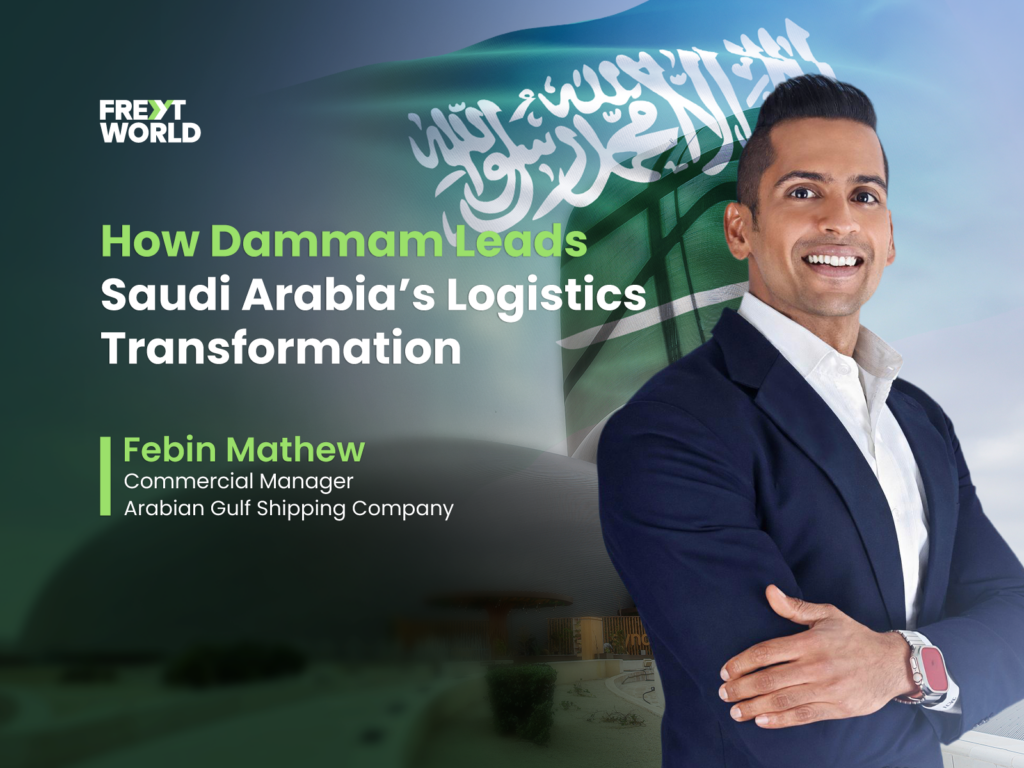
By Febin Mathew, Commercial Manager, Arabian Gulf Shipping Company
For decades, the Kingdom of Saudi Arabia was viewed primarily through the lens of its vast energy reserves, but today, a new narrative is being written, one defined by connectivity, diversification, and technological innovation. At the heart of this shift lies the logistics sector, a cornerstone of Vision 2030, and the bustling coastal city of Dammam.
As the capital of the Eastern Province, Dammam has long served as a crucial industrial hub. However, its role is rapidly evolving from a traditional port city into a sophisticated global gateway connecting Asia, Europe, and Africa. For logistics professionals and global shippers, understanding the dynamics of this region is no longer optional; it is essential for capitalizing on the Middle East’s next phase of growth.
To navigate this complex and promising landscape, we turn to Febin, a seasoned expert at Arabian Gulf Shipping Company in Dammam. With deep roots in the region’s freight forwarding industry, Febin offers a unique perspective on how local expertise is driving global success.
The Strategic Pulse of the Eastern Province
Dammam is not just a city; it is the heartbeat of Saudi Arabia’s industrial output. Home to the King Abdul Aziz Port, the second largest in the country, it handles a massive volume of the Kingdom’s non-oil exports and imports. The strategic importance of Dammam extends beyond its docks. It sits at the crossroads of the Gulf Cooperation Council (GCC) countries, offering seamless land connectivity to neighbors like Kuwait, Bahrain, and the UAE, while serving as the primary entry point for goods destined for the capital, Riyadh.
“Dammam is unique because it functions as a dual gateway,” explains Febin. “On one hand, you have the massive maritime throughput from the King Abdul Aziz Port, which is undergoing significant modernization. On the other hand, it is the undisputed hub for cross-border land transport in the Gulf. For our clients, this means Dammam is often the most efficient distribution point, not just for Saudi Arabia, but for the wider region.”
This dual capability is critical as global supply chains face increasing pressure to find resilient and faster routes. The Saudi government’s massive investment in infrastructure, connecting ports to railways and industrial cities, has positioned Dammam as a model for multimodal logistics. The integration of the port with the dry port in Riyadh via rail has drastically reduced transit times and road congestion, a development that forwarders like Arabian Gulf Shipping Company are leveraging to optimize supply chains.
Vision 2030 and the Logistics Boom
Saudi Vision 2030 is the blueprint for the country’s future, and logistics is one of its primary pillars. The National Transport and Logistics Strategy aims to position the Kingdom as a global logistics hub, targeting an increase in port capacity to more than 40 million containers annually. For the freight forwarding community, this national agenda translates into tangible opportunities and rapid changes on the ground.
The initiative focuses heavily on economic diversification. While oil and gas remain vital, there is a surge in sectors such as construction, retail, pharmaceuticals, and manufacturing. This diversification requires a logistics partner who understands the nuances of handling varied cargo types, from temperature-controlled pharmaceuticals to heavy-lift project cargo.
“We are seeing a shift in the types of commodities moving through the Eastern Province,” Febin notes. “Ten years ago, it was predominantly energy-related equipment. Today, with the giga-projects and the push for local manufacturing, we are handling everything from high-end construction materials to raw materials for new factories. Vision 2030 has effectively opened the floodgates for diverse trade, and the logistics infrastructure is racing to keep up.”
This boom, however, brings its own set of challenges. The influx of volume requires precise coordination and deep knowledge of the regulatory environment. This is where the value of a local "thought leader" becomes apparent. It is not enough to simply book space on a vessel; one must understand the strategic direction of the country to anticipate regulatory shifts and infrastructure developments.
Navigating Customs in a Digital Era
One of the most profound changes in Saudi Arabia’s logistics sector is the digitization of customs and border procedures. The introduction of the FASAH platform, an integrated system for import and export procedures, was a game-changer. It aimed to reduce clearance times from days to hours, increasing transparency and efficiency.
However, technology is only as good as the operators who use it. For international businesses, the Saudi customs environment can still appear complex due to strict compliance standards and evolving regulations.
“Digitization has undoubtedly streamlined operations, but it has also raised the bar for compliance,” says Febin. “The margin for error is smaller now. Incorrect documentation or misclassification can lead to delays that digitized systems will flag immediately. At Arabian Gulf Shipping Company, we invest heavily in keeping our team updated on these digital shifts. We act as the bridge between the digital efficiency the government offers and the practical realities our clients face.”
This "bridge" role is vital. While the systems are automated, the expertise required to navigate them, understanding SASO (Saudi Standards, Metrology and Quality Organization) certifications, specific labeling requirements, and prohibited items, remains a deeply human skill. Febin emphasizes that successful clearance in Dammam today is about preparation.
“We tell our partners that the clearance process starts before the cargo leaves the origin,” Febin advises. “By validating documents and ensuring compliance with Saudi standards locally before shipping, we ensure that when the goods hit Dammam, they move through the 'green lane' of customs smoothly. It is about being proactive rather than reactive.”
Project Cargo and Industrial Expertise
The Eastern Province is synonymous with heavy industry. With major players like Saudi Aramco and SABIC headquartered in the region, Dammam is the epicenter for project cargo and heavy-lift logistics. Handling these colossal shipments requires more than standard freight forwarding capabilities; it demands engineering precision, route surveys, and specialized equipment.
The resurgence of infrastructure projects under Vision 2030 has revitalized the project cargo market. From power plants to desalination facilities, the equipment entering the country is massive and critical to the national timeline.
“Project cargo is in our DNA here in Dammam,” asserts Febin. “You are dealing with cargo that cannot wait and often cannot fit on standard transport. We recently managed a movement of industrial turbines that required months of route planning, obtaining special road permits, and coordinating with port authorities to ensure the vessel had the right berth priority. In this region, a delay of one day can cost millions in project downtime, so our operational precision must be absolute.”
This expertise is a key differentiator for Freyt World members. While general cargo can often be commoditized, project logistics in Saudi Arabia relies heavily on relationships and reputation. Knowing who to call at the port, which heavy-transport operators are reliable, and how to navigate the physical obstacles of road transport in a developing city are insights that only a local expert like Febin can provide.
The Role of Warehousing and Distribution
As consumer behavior in Saudi Arabia shifts towards e-commerce and just-in-time manufacturing, the demand for sophisticated warehousing solutions in Dammam has skyrocketed. The government is establishing Special Integrated Logistics Zones to attract foreign investment, offering tax incentives and relaxed regulations.
For foreign companies looking to penetrate the Saudi market, Dammam offers a strategic vantage point for warehousing. It allows for rapid distribution to the population centers of the Eastern Province and Riyadh, while being cost-competitive compared to other major Gulf hubs.
“Warehousing is the new frontier for us,” Febin observes. “Clients are no longer just looking for transit; they want value-added services. They want us to strip containers, palletize goods, label them for local retail, and manage the final mile. We are transforming from pure forwarders into supply chain integrators. The demand for bonded warehousing and temperature-controlled storage in Dammam is outpacing supply, which is why we are constantly expanding our capabilities to meet this need.”
This trend aligns with the global shift towards resilience. Shippers are looking to hold stock closer to the end consumer to mitigate supply chain disruptions. By utilizing Dammam as a distribution hub, companies can insulate themselves from volatility in global shipping lanes.
Sustainability and the Future Workforce
Looking ahead, two major trends will define the logistics landscape in Dammam: sustainability and talent development. The Saudi Green Initiative aims to reduce carbon emissions and protect the environment, a goal that is slowly filtering down to the logistics sector. From cleaner trucks to energy-efficient warehouses, the industry is beginning to adapt.
Simultaneously, the "Saudization" (Nitaqat) program is reshaping the workforce. This initiative encourages the employment of Saudi nationals in the private sector. In logistics, this has led to a new generation of young, tech-savvy Saudis entering the field, bringing fresh ideas and digital fluency.
“The energy in the office has changed,” Febin shares. “We are seeing young Saudi talent who are eager to learn and adapt to new technologies. This is crucial because the future of logistics is digital. Combining their local knowledge and digital native skills with our established expertise creates a powerful team dynamic. It ensures that we are not just a company operating in Saudi Arabia, but a part of the country’s organic growth story.”
Dammam is no longer just a dot on the map for oil exports; it is a dynamic, multi-faceted logistics powerhouse driving the ambitious goals of Vision 2030. For global businesses, the opportunities in this region are immense, provided they have the right guidance to navigate the cultural, regulatory, and operational nuances.
The transformation of Saudi Arabia’s supply chain is moving at a breathtaking pace. Whether it is navigating the digitized customs landscape, managing complex industrial projects, or establishing a strategic distribution hub, the key to success lies in local partnership.
As Febin and the team at Arabian Gulf Shipping Company demonstrate, the future of freight in Saudi Arabia is bright, open, and increasingly connected to the world. For Freyt World members and clients, having a partner in Dammam who combines global standards with deep local insight is the ultimate competitive advantage.
“Saudi Arabia is open for business,” Febin concludes. “And Dammam is the front door. We are here to ensure that when you knock, the door opens wide and your cargo moves without a hitch.”

Freyt World Blog Contributor
Freyt World is a global logistics network uniting members from around the world. Our mission is to revolutionize global logistics through collaboration and innovation. Our platform goes beyond networking, enabling members to excel and grow together, featuring articles by logistics professionals for their peers. This series will cover industry-relevant issues and news, providing valuable insights for professionals in the field.
Read more Freyt World Blogs ⇲
- Mauro and SQL Take on a 16-Case OOG Shipment to Benghazi
 Mauro International Services and SQL Shipping worked together on a 16-case shipment to Benghazi, including five OOG units requiring flat racks, exceptional road permits, technical escorts, night port access and certified lashing.
 - The Timing Challenge Behind VDM and Airways’ Breakbulk Shipment to Brazil
 VDM and Airways managed a breakbulk kiln shipment from Durban to Santos, keeping the cargo ready while a shifting vessel ETA made port timing and storage costs the biggest challenge.
 - GTZ Shipping Connects the World to Maldives Paradise Island Resort
 GTZ Shipping has supported hospitality projects in the Maldives for 28 years, coordinating international freight, cargo handling, and island delivery. This article looks at the logistics involved in moving furniture, equipment, and project cargo from global suppliers to resort sites.